

The Amazon, a dream come true
For a long time now, thanks to videos made by Cyril Chauquet (Fishing enthusiast, XXL Fishing), Jeremy Wade (River Monster) and other famous unknowns on Youtube, a trip to the Amazon and the hunt for the famous " Peacock Bass " caught my eye. Ultimately, year after year, for lack of a real opportunity and due to the lack of support from my fishing companions who preferred other destinations, the idea took hold but struggled to become real.
In the end, after a discussion with my buddy Eric Gracia (the boss of Kuruk) who has traveled to almost every fishing destination in the world and who had just returned from an incredible trip to Brazil, I managed to convince my friends to go back with him the following year. The promise of incredible scenery and a true adventure at the end of the world in this immense jungle called the "Lung of the Earth" and which is also the largest biodiversity reservoir in the world, could no longer leave us indifferent.
The Peacock Bass (Peacock Fish or Tucunaré) is not only considered one of the most combative freshwater fish in the world, but it also has splendid colors. There are 16 species, including 3 in this Amazonian area: the Temensis (which changes color according to its sexual maturity as Paca, Pacaçu or Açu), the Monoculus (Popoca), and the Orinocensis (Borboleta), and just this fish alone could justify a trip. However, we also hope to catch other types of fish such as the Aimara, the Pirahiba (large catfish), the Pirara (red-tailed catfish), the Payara (saber-toothed fish), or the legendary Piranha.
The idea is to go to northern Brazil, at the gates of the Amazon (which is present in 11 countries, but 63% of which is in the Carioca country), then to leave on a "Boat-Hotel" that can navigate to the different spots offered by this huge playground. Then, canoes, each with 1 local guide and 2 fishermen, will roam the areas in search of these superb fighters.
The dates are set, they are exactly the same as last year because the conditions were perfect. So we are going to Brazil with the Franco-Portuguese guide Antonio Da Silva and his organization voyage-pêche.com. We book the plane tickets with his partner agency, for the rest everything is included (hotels, restaurants, transportation, etc.).
After months of exchanges on a WhatsApp group, we know the equipment and lures to use. The fish are very powerful, but the lures used are not very heavy (nor big), so for optimal fishing comfort, I will bring 3 sets. For my part, it will be 2 Casting sets and 1 Spinning set. A Huerco in 10-45 grams special "Peacock Bass", short, light but powerful (XT510-4C+). Another one in 10-40 grams and a spinning 7-25 grams to fish for small Piranhas. The reels must have high gear ratios (which retrieve a lot of line per turn) because the lures used must be animated quickly. Not having a suitable reel, I will try 2 Chinese reels, the Kasting MegaJaws (ratio of 9.1) and the Kasting Speed Demon which boasts being the reel with the highest ratio on the market (ratio of 10.5). Not having much confidence in these reels bought cheaply on AliExpress, I will also take my faithful Daiwa Steez and Daiwa Zillion which have a lower ratio but whose reliability I am sure of.
For the lures, they are mainly Brazilian lures from the Borboleta brand distributed in France by Fish Connection, and notably the two lures: The Perversa, which is the best-selling floating twitch bait in Brazil and which really was unanimously appreciated during the trip, and finally the iconic propeller lure the "Wood Stock". Some lipless crankbaits and also the traditional and essential Bucktails Jig (bought on AliExpress for my part) will complete the boxes. Of course, we all took plenty of lures that did not find takers in the water. If I had to leave again with lures, it would be the 4 mentioned above.
There are 10 fishermen leaving, from the Nice area, and if you are used to reading me, you will find familiar faces: Odin, Jérôme, Virgile, Rémi, and a newcomer: Olivier. 6 fishermen from Nice (including me) plus Eric Gracia (the boss of Kuruk), his friend Eric with his son Luc, and finally our guide Antonio.
Arrivaouuuu ô Brazioooooo (My version of "Chegada ao Brasil")
So we all meet at Roissy for a first night flight to Sao Paulo with LATAM airline. When we meet, Eric immediately tells us he is not reassured about the weather of the last few days because it rained a lot and the waters have risen a lot. We tell ourselves we have time for it to go down, and since we do not know this ecosystem at all, it does not bother us.
After a long 11-hour night flight and very little sleep for my part (I have a hard time sleeping on planes), we arrive in Sao Paulo and after customs and baggage claim, we take a new 3 hour and 30 minute flight to Manaus, again with LATAM. Nothing to report on this airline. I had checked before because I was not too reassured, but they make almost 10 billion in annual revenue and carry several tens of millions of passengers per year. In terms of quality, it is at the same level as Air France. No worries then. Arriving in Manaus and at the baggage claim, we realize we are in the land of fishermen, half the passengers are fishermen. There are rod transport tubes everywhere, and we realize we are at the gates of the Amazon.

We arrive around 10:30 at our hotel in Manaus, a nice little hotel next to a church and located in the tourist area of the city. You should know that Manaus is large, it is actually the largest city in the Amazon, with a little over two million inhabitants. This city exploded around 1850 with the discovery of rubber. The harvesting of latex which takes place in the Amazon forest gave a huge boost to the economy and transformed a simple village into the "Paris of the tropics". Huge fortunes were made until 75 years later, rubber from Indonesia and Malaysia, much cheaper, sent Manaus back to the stone age. It is now one of the most dangerous cities in Brazil. For now, nothing suggests that, and after dropping off our things, we take our minibus and our driver takes us to a kind of American-style shopping center. We head to a restaurant in the "food court" and can finally enjoy our first Brazilian beer with a good pork knuckle. After the meal, we go directly to the fishing store in the mall (hence our presence here). We buy some lures again (as if we didn't have enough), and the pressure begins to rise gently. We meet Brazilian, Swiss, Belgian, Italian, American fishermen, the store is always busy, and around 4 pm, we return to the hotel. After some rigging, sorting the boxes and chatting, we go for an aperitif on the large square next to our hotel. The first caipirinhas arrive and prolong the pleasure until dinner at the restaurant next door (the Tambaqui de Banda), where Eric praises the Costela de Tambaqui (Tambaqui ribs), which according to him is the best freshwater fish he has ever eaten. We will have a traditional local menu, and indeed the fish is delicious, except the flesh near the tail which tastes like mud. Eric tells us: "I warned you to only take the ribs!" After a few more beers in front of an Amazonian singer with his local dancers, we go back to the hotel for a night full of dreams of jungle, fish, Indians and fierce beasts.


The next morning, we set off again to Manaus airport to take a 14-seat plane for a short 1 hour and 15 minute flight to Barcelos. I am clearly not reassured, but my passion for fishing is stronger than my apprehension, and I reason myself about the probabilities of a crash… The plane is mainly made up of our group and 2 very friendly Brazilian fishermen. The weather is nice, and we fly over the incredible Amazon forest. The view of this gigantic space from this tiny plane is incredible. We fly over the Rio Negro (Black River) which will be our playground for the week. The Rio Negro originates in Colombia and is a tributary of the Amazon River, which it joins near Manaus. It gets its name from its dark color due to its high concentration of iron and organic matter from the forest soils it crosses. To give you an idea, its length is three times that of the Seine (2250 km versus 774 km) and its basin is almost ten times larger (691,000 km² versus 79,000 km²). When we land, it is a relief, I can finally fully devote myself to fishing! A pickup and a minibus come to pick us up and take us directly to the port of Barcelos. This city of 27,000 inhabitants is the last before the jungle and the scattered small villages that make it up. It mainly lives on fishing and fish export for aquariums, particularly the Cardinal Tetra, which makes up the majority of domestic aquarium populations worldwide. Of course, it is everyone's starting point, the last semblance of civilization before the jungle. We meet tribe members who come to trade, adventurers of all kinds, merchants, and of course fishermen. The drivers drop us off at the port and help us carry our bags to the dock, where our boat, the "Sebastiao Borges", awaits us alongside many other similar boats. The boats used in the Amazon look a bit like the boats that sailed on the Mississippi, but without the steam wheel! They are multi-level boats, and come in all sizes. Some are used to navigate for days (you can actually reach Barcelos from Manaus in 2 days of navigation). I am very pleasantly surprised by the comfort of ours. We share cabins in pairs (with bunk beds), but each cabin has its own bathroom with toilet, and, the height of luxury, they are air-conditioned! The crew is quite large: there are 3 Brazilian women who take care of cooking, cleaning and laundry. They are smiling, polite, but very discreet. We hardly see them outside their kitchens. I think they must have had problems with groups of fishermen alone in the jungle in the past, and they prefer to see us as little as possible. Then, there are 9 Brazilians, including Anderson who is the maître d'hôtel. He makes sure we lack nothing and is present during all our meals to serve us and take care of us. The boat has a captain and 1 or 2 sailors, and finally, we have 6 local fishing guides. With our group of fishermen, that makes 23 people. Another smaller boat, called the "support" boat, also carries supplies and water, and serves as a camp for the guides who sleep in hammocks there. This small boat is attached to ours permanently and follows us like a leech throughout our trip.


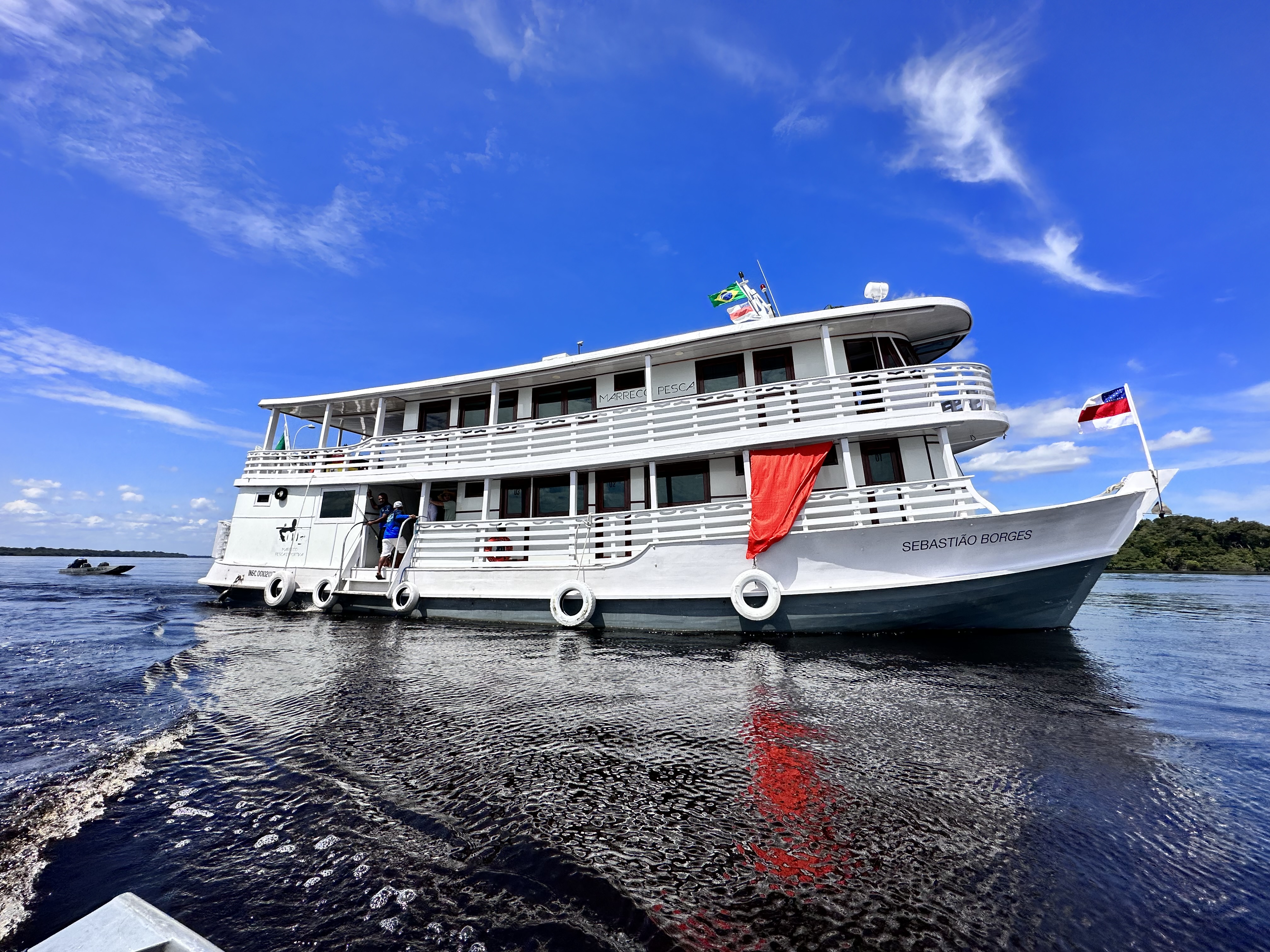


Eager to get started!
Barely boarded, we start our journey to the first fishing spot which is a few hours away by boat. We take possession of our rooms and start unpacking our things. It's time for our first lunch in the large dining room, which is a buffet offering various simple but good Brazilian specialties. There is a wide variety of dishes, fish, chicken, pasta, rice, beans, salad and manioc flour, with which Brazilians season many dishes. Once full, the team offers us a great cap with the "Tucuna" organization logo, and Antonio asks us to get ready because we will have the opportunity to fish late in the afternoon and try to catch our first Amazonian fish. Night falls relatively early, we will only have 3 hours to fish, but it is more than enough for us to be super excited to start.


So I go with Virgile on a canoe, accompanied by one of our guides whom we later nickname "Boca". The Rio Negro is huge, dotted with islets, canals, lagoons and bays. After a few minutes of navigation, our eyes widen at this lush nature, and we quickly become unable to know where we are in relation to the mother boat. If something happened to our guide, we would be quite unable to get back. We will understand a few days later that it would have been dramatic, as it was extremely rare to encounter a living soul during our stay. Neither the other canoes of our team, nor any other boat, nor any human in fact… Fortunately, no disaster occurred. Contrary to what we thought at first, we never felt in danger during the trip. No insects, no snakes, no spiders, very few caimans (Jacarés) although 3 million reptiles are recorded in this part of the world. The animals are afraid of humans and hide as much as possible. We were able to see some monkeys, some Jacarés and especially many beautiful birds (macaws, parrots), but that’s it. I found the trip physically much less difficult than our bivouac in Panama or even our long hours of fishing and short nights in Sweden. Despite the destination and against all expectations, it is rather a "cool" trip in the sense that it is very comfortable. Of course, we very rarely left our boats, and it would certainly have been a whole different matter if we had to walk in the jungle.
The principle of fishing is quite simple. Most of the time, after a few minutes of navigation, the guide points to a bank and asks us to cast. Before continuing on fishing, I will make a confession: it is the first time in my fishing life that I find myself unable to communicate easily with a guide. I speak English fluently and I manage in Spanish. Most of the time, these two languages, plus French, are more than enough to be understood worldwide, but not in Brazil… They only speak Portuguese. I had downloaded a translation app, but our guides could not read either. So it was very complicated to have fluid conversations. Of course, we mumbled a few words of "Portuñol" which sometimes seemed to resonate, and we recognized some snippets of words. All this was mixed with gestures and body language that still allowed us to communicate a minimum. It was super frustrating for me, not only regarding fishing, but also to understand their way of life, their culture, etc. Fortunately, Antonio was there on the mother boat, and at least we could have general information and answers to our questions, not to mention the overall organization of the trip which without Antonio would have been much more complicated. Back to fishing. After a few brief exchanges with "Boca", who tells us nothing particular about how to fish, he looks at our lure box, and depending on the spots, he points to this or that lure, their great preference being the Perversa and the Bucktail Jig.
With every nice cast we make into a break in the vegetation or between two trunks, our guide treats us to a "Boca Del diablo" or "En la boca", hence his nickname. All this makes us think that we are fishing quite well despite the hour we just spent without a single bite. The waters are indeed very high, we will be told a little later why fishing is complicated. To put it simply, the water levels of the Amazon in general, and the Rio Negro in particular, vary enormously, up to 20 meters difference. When levels are low, fish are grouped in the main tributaries or trapped in lagoons. It is then easier to find them, and above all, they are concentrated in the same place. On the other hand, when levels are high, the river and tributaries overflow, and the forest is flooded. Fish then find refuge in these spaces protected from their main predators: alligators and Botos (pink dolphins), but also from our canoes. The whole challenge when waters are high is to try to find where the fish are accessible, and our guides will struggle all week to find solutions.
After an hour and a half of fishing and about a hundred casts, we are still empty-handed, and we tell ourselves that if it is like this all week, it will be difficult. We know that fishing is often complicated, but our wildest dreams promised dozens of fish per day and bites galore. We traveled thousands of kilometers for this, and despite our experience and attempts at rationalization, it is always difficult to tell ourselves that we did not come at the right time. Finally, Boca asks me to put on a Bucktail, and after a few minutes, I catch my first fish. I feel a nice bite, I set the hook, and there I see my first modest-sized peacock jumping trying to get off. It's a "Tucunare Pacaçu". It fights well, but I am not impressed either. For me, it is no more violent than a perch or a slightly angry largemouth bass. It is quickly on dry land, and I can finally take my first photo. Upon release, it can take up to 3 seconds for a huge Raouf to pass in the water… A Boto (pink dolphin) threw itself on my fish and swallowed it. We understand why fish hide in the forest. These mammals are clever and count on us, fishermen, to make the fish come out of their hiding places with our lures to ensure their meals. On our side, the lesson is learned, and we make sure to release all our fish in the forest from now on. I will quickly catch 2 other fish, another Paca and my first Borboletta, which is very pretty with its spot on the tail that looks like an eye for other predators. Virgile is skunked while night is about to fall, and we head back to the mother boat for a well-deserved aperitif. The assessment falls, it is not a big evening bite, but almost all fishermen have caught at least a few fish, and the Antonio / Eric duo did well with 6 or 7 fish each. After a few caipirinhas and a good shower, we meet for dinner. We are not tired yet, and the evening lasts until midnight, when we decide to go to bed because fishing resumes at 6:30 the next morning.


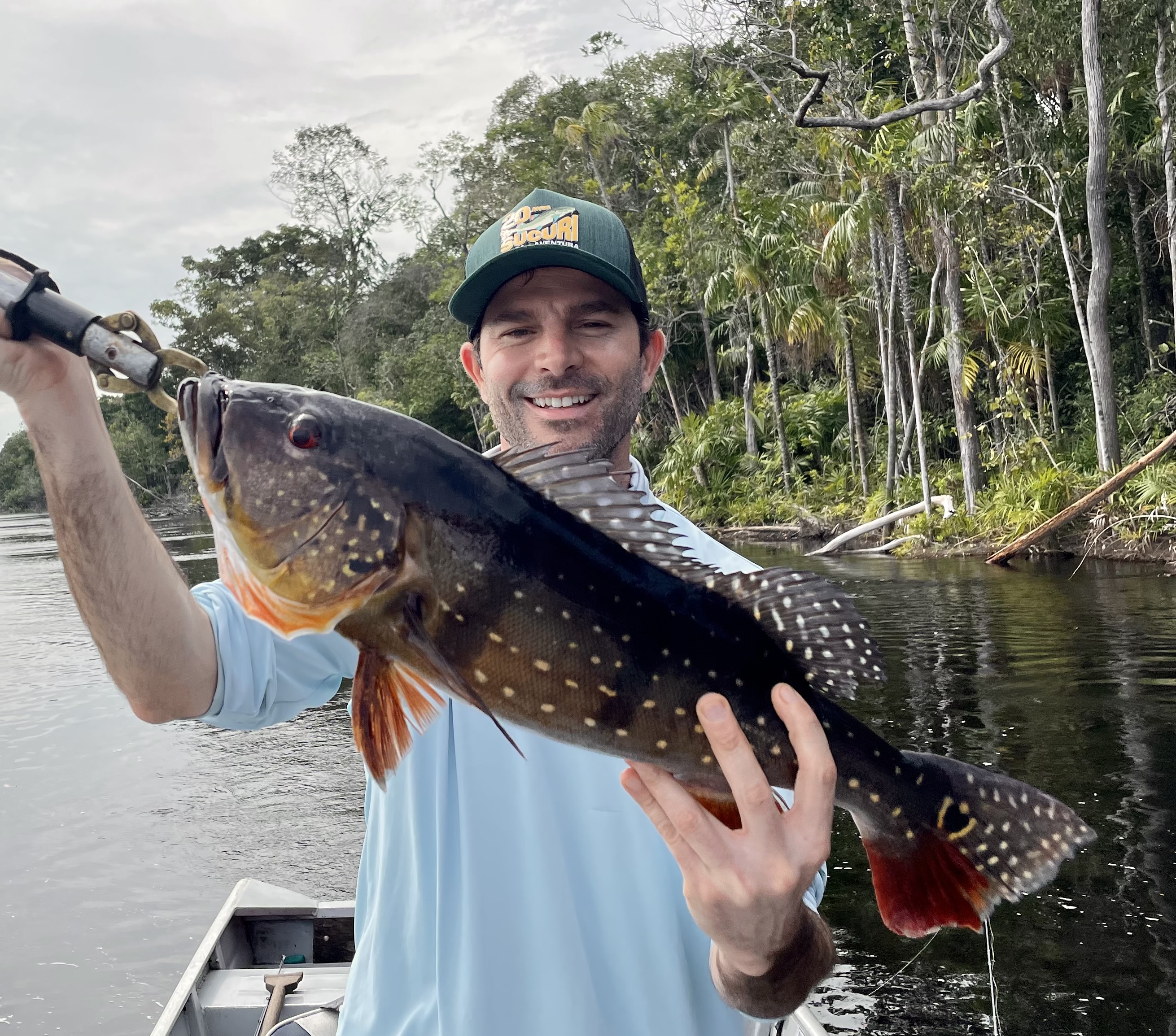


Day 2: So yes, now I understand!
This morning, I team up with Eric while Virgile goes with Antonio, because given their scores yesterday compared to ours, we tell ourselves maybe we are doing something wrong. So, in order not to miss the trip, better learn from the start. Finally, Eric and I are empty-handed in the morning, despite beautiful places and spots that smelled fish all over. In the afternoon, I go on the canoe with Antonio, and we manage to find a flooded forest where fishing is much better. I catch 2 Borboletta, my first Popoca (which is also a Tucunare), 1 Paca and my first 3 Aymaras. These last ones are really small, but I am super happy because it is a mythical fish which is, like all its Amazonian comrades, extremely violent in its attack. To catch them, you have to cast your lure in all areas where there is no water… 10 cm of water is enough for it, you feel the fish used to hunting terrestrial species. We have a great time in this little forest, and above all, Antonio treats us to two superb fish, a 57 cm Tucuna Açu and a superb 62 cm Paca. I filmed everything, and as you can see, it is a real fight and superb fish. I was able to measure the genuine power of this fish that afternoon, because I also had the chance to touch a nice one. This one clearly gave me no chance. It took 5-6 meters of line while my reel was tightened to the max, and the braid did not hold against the many underwater obstacles… It is 50 pounds (resistance about 25 kilos), but nothing can stand up to these super powerful beasts. A little information, if the mythical pike bar is 1 meter, that of the Peacock (Tucunare) is 80 cm. If we manage to catch this grail, the organization offers us an "80 UP" cap, and it is the goal of fishermen from all over the world who come to fish this fish in the Amazon. Given the power of a 62 cm, I imagine that of the 80 cm (which can weigh up to 10 kilos), it must be phenomenal. Antonio completes his catch with 4 Aimaras and 1 Bicuda (a kind of small Amazonian barracuda). The others also more or less caught fish, it was really alternating. Eric is very disappointed compared to the scores achieved last year, he puts pressure on himself for us, but it's fishing, and we are still super happy to be here in a magnificent setting.


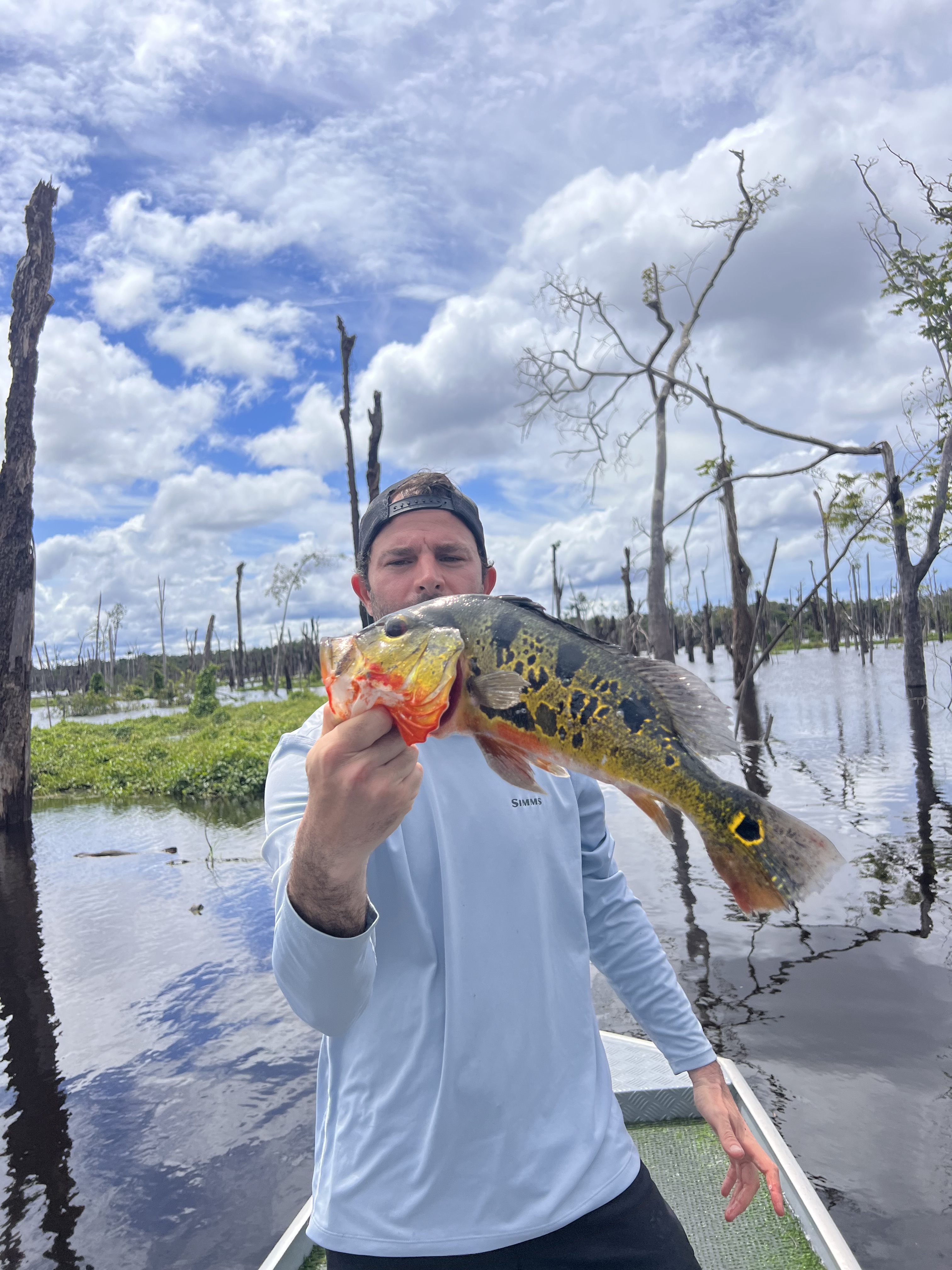


Day 3: Jacare Dundee Day
Today, I team up with Rémi, the poor "Boca" from the first day who didn't get very good results and was shunned by the entire group of fishermen we are. No one wanted to take him. However, after analysis, no guide got better results than the others. They are all skilled and know their job perfectly, but when the fish don't show up, they are not magicians…
In the morning, we each catch 2 Paca, including a beautiful 57 cm specimen for Rémi (Pacaçu). As for me, I continue to settle for small fish, as well as 1 Bicuda and 2 piranhas that literally destroyed my Bucktail Jigs. In the afternoon, I finally manage to catch my first Tucunare Açu, probably my only fish over 50 cm during the entire stay… I actually think I caught the smallest fish of the whole group. Now, when I look at the photos while writing these lines, I confirm it to you, my companions all caught prettier fish than me!


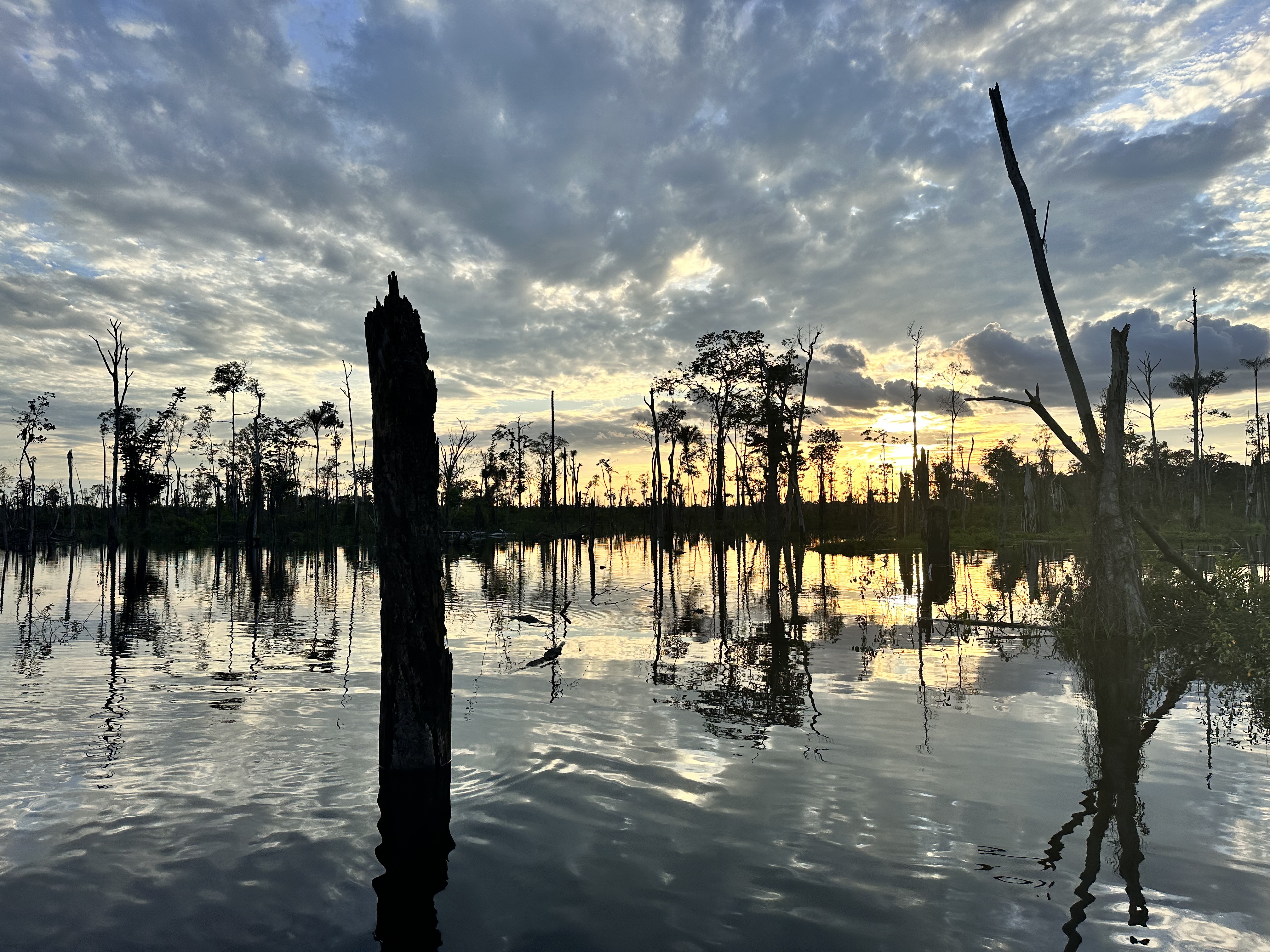
As I mentioned, the water is still way too high, which makes fishing difficult. However, the landscapes are absolutely magnificent, and we feast our eyes. Today, we finally saw our first Jacaré (Caiman), and we fished on a lagoon that gave the water a red color (white sand + heavily tinted water).

That same day, Jérôme, aka "the Guatemalan," treats us to a superb 68 cm Açu specimen with a surface propeller lure. It was his only fish of the day, but what a fish!


In the evening, we fish a little with meat from the boat and catch a small catfish. Then, five of us had the chance to go night hunting for Jacarés. The experience is exhilarating, and those who lived it have great memories. I had given up my spot this time and was supposed to go another day, but it never happened. They killed a big one and brought back a small live one for us to see. Of course, it was released.


That same evening, the two canoes that had gone looking for Jacarés came across a boat broken down in the middle of the Rio Negro, signaling with its torch. It's incredible, but it was the boss of our organization who was joining us with his brand new bass boat, which had broken down. It was completely improbable, especially since he was equipped with a satellite phone that unfortunately had no battery left.
Day 4: Robinson BBQ!
Today, I share my canoe with Odin. I start quickly by catching 4 bicudas near a kind of beach point, and I manage to catch my first and only Jacunda of the trip in a flooded forest. We also spot a very large Jacaré sunbathing. Fishing is really difficult for everyone, and we are happy to meet for a good barbecue on a beach during the lunch break. The water is beautiful, and the guides prepare us a feast of sausages and piranhas. Curiously, they don't want to mix too much with us and eat on their own. I don't know if it's out of modesty or for another reason, because although they are quite friendly and smiling, the language barrier would have limited our interactions anyway.
They brought hammocks, and we rest a bit before heading out again for another afternoon under this stifling heat and high humidity.


In the afternoon, we return to the flooded forests. I specify that we only see the upper part of the tree trunks emerging from the water, but neither the ground nor the base of the trees. Finally, I manage to catch a beautiful fish with the famous propeller lure. It's a satisfaction because it allows us to observe the surface attack of a small Paca.


It is extremely hot, and fishing remains really difficult. Odin is not very motivated, and we decide to try live bait fishing for fun with the piranhas. However, even these fish don't seem interested in our bait. Odin saves his record with 2 piranhas, while I lose two pieces of my leader.
Day 5: Grrrrr!!!
This day was the worst for me during the entire stay. While I team up with Jérôme, I break off on my only bite of the day, which seemed to be a very big fish. Jérôme, meanwhile, manages to catch a beautiful Pacaçu on the Popper as well as a big piranha. Overall, fishing is difficult, and we have few catches to put under our belt.


At noon, a delicious barbecue composed of sausages, pork ribs, piranhas, and a Borboletta that unfortunately did not survive, lifts our spirits. Most of the time, we drink a lot of water, some beers, and a local guarana-based soda to stay hydrated.


On another boat, Virgile manages to catch 2 superb fish, one of 60 cm and the trip record at 74 cm!


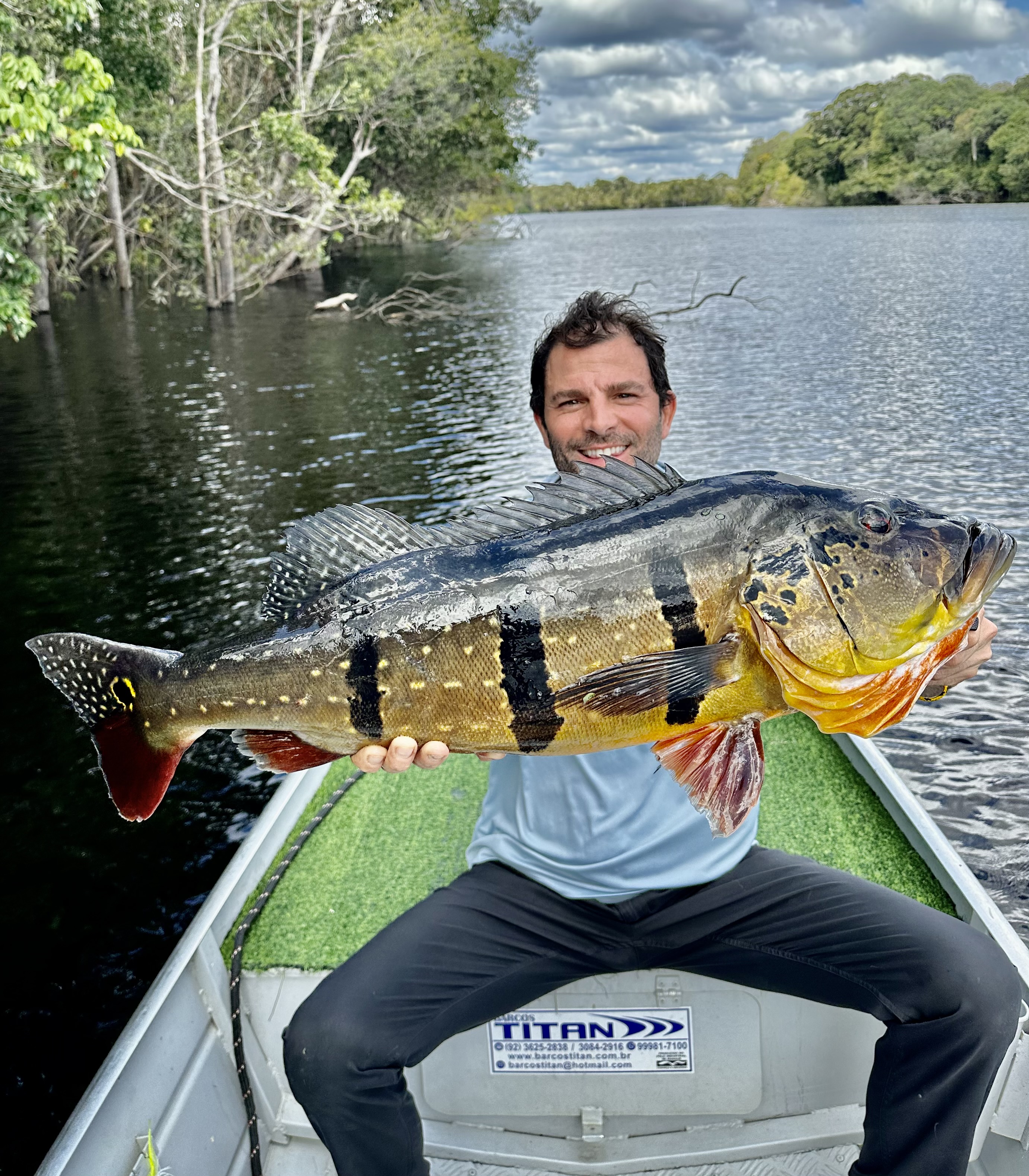
Luc and Eric, the father and son, are adapting better and better to casting fishing. They catch fish almost every day without ever complaining. They are always in a good mood and have nothing to say. It's Luc's first trip abroad, and he enjoys every minute of the show. For me, it's really touching to see Eric and his 16-year-old son share this passion for fishing. It's a dream for me that my son Archibald can have the same passion as me and discover the world through this activity. I try not to push them and let them come to this passion at their own pace. I already know that my daughter Mila is not as enthusiastic; she likes fishing but not enough to travel the world and fish 12 hours a day with the risk of encountering unidentified flying insects (or not). It's hard for me to travel without my family, but I need it, and I would feel less guilty if one of them could accompany me.

You often see people on the Internet asking for family-friendly fishing destinations, but I'm not sure it's really compatible. I can't imagine traveling the world with family and not seeing them for 12 hours a day, only to meet them again in the evening. Almost all destinations are focused on fishing. I fished during our family vacations in Guadeloupe, Mexico, Florida, Brittany, but it was not really a fishing trip. I'm not opposed to it, but I don't plan to organize a family fishing trip. We decide on a family vacation destination, and if I can fish a little, great. Otherwise, too bad. Besides that, I have my 100% fishing trips, and I hope to take my son one day, or even always, as long as possible.
Day 6: Fogo de Chao
It's our last full day on the water, and I team up with Olivier, who joins us for the first time. He is Rémi's usual partner, and like him, he prefers freshwater fishing, preferably fly fishing. Olivier, like Jérôme, is constantly in a good mood, and it's a pleasure to fish with him. It's not that the others aren't pleasant to fish with, but it's different with them. The fishing result doesn't seem to affect their mood, while for others, including me, it can clearly influence our behavior. For example, when it doesn't work, I tend to be silent. I'm ultra-focused, almost in competition mode, trying to find the right way to catch fish. My partner might think I'm sulking, but in reality, once fishing is over, I quickly regain my joy of life.
Others may swear and lament, while some desperately look for a culprit, whether it's God, the wind, the guide, the reel, the lure, or even their partner…
In the morning, I catch a piranha and a borboletta, while Olivier catches a Paca. In the afternoon, I catch another Paca, but Olivier comes up empty. The day is still very difficult, fortunately and as always, some boats manage to find a good spot.


In the evening, the Brazilians prepared us a superb dinner around a traditional local specialty called "Foga No Chao." It is a large barbecue where the meat is cooked vertically over the embers. They chose a beautiful beach for this. The mother boat is stranded on the beach, so we can dine with our feet in the sand. The table is beautifully set, they set up a bar, string lights, music, and the view is simply superb. Once again, the Brazilians eat on their side, and this time, we see a bit of the three Brazilian women. They must have understood that we are not predators and are less shy. I can't help but plant my Nice flag on this beautiful beach. We take stock of our trip which is coming to an end. Yes, fishing was difficult, but it was an extraordinary adventure.


Day 7: Arrival in Barcelos
For this last morning, I team up again with my brother. We will fish for 4 hours before returning directly to Barcelos by canoe. So it's a power fishing session, where we cast our lures several times on different spots in a short time. This approach seems to work quite well, because during this morning, I catch three species of Tucuna (a Pococa, a Pacaçu, and an Açu) as well as a bicuda. Virgile catches two Aimaras. When we approach Barcelos, we see our mother boat moored on an island opposite the city, in the middle of the Rio Negro. It's the end of our fishing adventure. We join the boat and start packing our things. After a last lunch, we say goodbye to the whole team who was really wonderful. They accompany us to the shore with our luggage to the dock of our hotel.


During this 6-day fishing trip, I caught 27 fish. I think that's about the average of our 10 fishermen, some did better, notably Eric (with 39 fish), Rémi and Antonio, others a bit less. Last year at the same time, it was at least double. That's fishing. It's impossible to predict what will happen. We did our best and didn't give up, the rest depends on nature.
Upon arrival at the hotel, we are met with a torrential downpour, the first since our arrival in the Amazon. We are relieved not to be on our canoes anymore. Our hotel is right in the city center, we take a good hot shower and go out for a little walk. Nothing spectacular, the city is not very interesting. We wait until the evening, when we meet in a pizzeria where almost all the fishing teams gather. Odin, the only one who didn't have pizza and opted for a hamburger, is very sick. Virgile doesn't feel well either… Finally, I think I'm the only one in the whole team who was not sick even once during the trip. Luckily our doctors had everything planned…


Day 8: Back to Manaus
This morning, we have to take the small internal flight between Barcelos and Manaus. The flight is supposed to be at 10:30, but with the wind and rain, we fear having to wait a long time. That's actually why Antonio only booked us a flight for the next day from Manaus. We see 3 or 4 flights arriving, each with a fishing team. I pity them a bit because with this rain, water levels will rise again, but well… For now, I'm more worried about taking my little plane with this wind and rain, I'm not very comfortable…


Finally, the flight is only delayed by an hour, and we arrive safely in Manaus. Our usual driver with the van is waiting for us and takes us back to our hotel (the same as on the way there). My brother Virgile is now very sick and won't come eat with us, he is at his worst… We are very hungry and immediately return to our first restaurant, Costello Del Tambaki. This time, we opt for Tambaki ribs and not the whole fish! Others choose a kind of local fish soup, in short, everything is excellent. In the afternoon, we decide to visit Manaus… No way to be here without enjoying the city a bit. We go to the large covered market, all on foot. At no time do we feel unsafe, people don't even pay attention to us… It must be said that the Brazilian people are so cosmopolitan that if they don't hear us speak, they can't know we are tourists… I'm delighted to find all sorts of crafts, piranha-shaped keychains, wooden fish sculptures, a blowpipe with arrows for my son, necklaces for my wife and daughter. Everyone shops and we stroll in Manaus, where it's market day.


In the evening, while Antonio wanted us to return to the usual restaurant, I plead for us to go to a restaurant that Antonio found for us through Eduardo our driver and made the reservation. We had a great evening (without Virgile still in agony), with meat and a good red wine, and as a highlight, a local specialty, the Banzeiro: a starter made of manioc foam and ants!


Day 9: Obrigado Brasil
The next day, we have our flight at 2 p.m., and we decide to return to the covered market to accompany Virgile, who is much better, as well as the others who didn't go the day before. Then, off to the airport to take three more planes… Manaus – Sao Paulo, Sao Paulo – Paris, then finally Paris – Nice… It's a long trip home, but we are all happy to see our families again. We were amazed, and this trip will remain engraved in our memories forever. One thing is certain, I will return one day to face again these powerful Amazonian fish… Meanwhile, I still have a trip to Sweden to tell, and a next trip planned in October in Ireland, where I will fish for pike from a float tube, one of my favorite species.

To finish, here is the video